


AI demand forecasting for grocery and food retail
AI-powered insights align inventory with demand to reduce waste, and exceed customer expectations, every time.


Say goodbye to inventory uncertainty
Traditional demand forecasting runs on overnight batch uploads, pushing recommendations into separate execution systems. The lag between forecast and reality is where stockouts and waste come from.
OrderGrid trains continuously on live sales data and feeds forecasts directly into replenishment on one unified platform.
Product availability
Deliver inventory accuracy over
Forecast accuracy
Improve demand prediction up to
Fewer missed sales
Cut stockouts by up to
Optimized inventory
Increase inventory turnover up to
Forecast smarter, sell more, waste less
Use AI to align inventory with demand, prevent overstocking, eliminate stockouts, and drive profits

Boost profits, reduce waste, capture every sale
Demand planning software for grocery aligns inventory with real demand. Avoid overstocking on perishables, eliminate waste, and maximize revenue opportunities across all product categories.

Prevent stockouts with accurate, location-based insights
Adapt to demand shifts with custom models that analyze historical sales, local weather, events, and promotions across fresh, frozen, and ambient categories. Adjust stock at the store-and-SKU level.

Save time and cut errors with AI stocking precision
Streamline inventory management with continuous demand sensing that automates forecasting and replenishment decisions on live data. Free up resources, eliminate human errors, and focus on strategic growth.

Build loyalty with reliable product availability
Proactively avoid stockouts to ensure customers find what they need. Build trust, drive repeat business, and deliver a superior shopping experience.
Integrate easily, deliver results fast
Inventory forecasting software needs to layer on top of existing ERP, POS, and WMS without a multi-year integration. OrderGrid is cloud-native and API-first, operational in 90 days alongside your existing systems.

Cutting-edge features driving the future of forecasting


Adaptive forecast engine
Our Champion and Challenger framework refines forecasts nonstop, ensuring superior accuracy and optimized inventory decisions.


Automated local insights
Harness hyper-local forecasting with AI, combining SKU data with local weather, events, and trends to uncover actionable insights and drive smarter decisions.


Flexible forecasting models
Choose from a range of pre-configured or tailored models designed to excel under specific conditions, ensuring accurate forecasts tailored to your unique data.


Data auto-processing
Automatically clean, preprocess, and validate uploaded sales data. Eliminate errors and ensure forecasts are based on accurate information.


Interactive dashboards
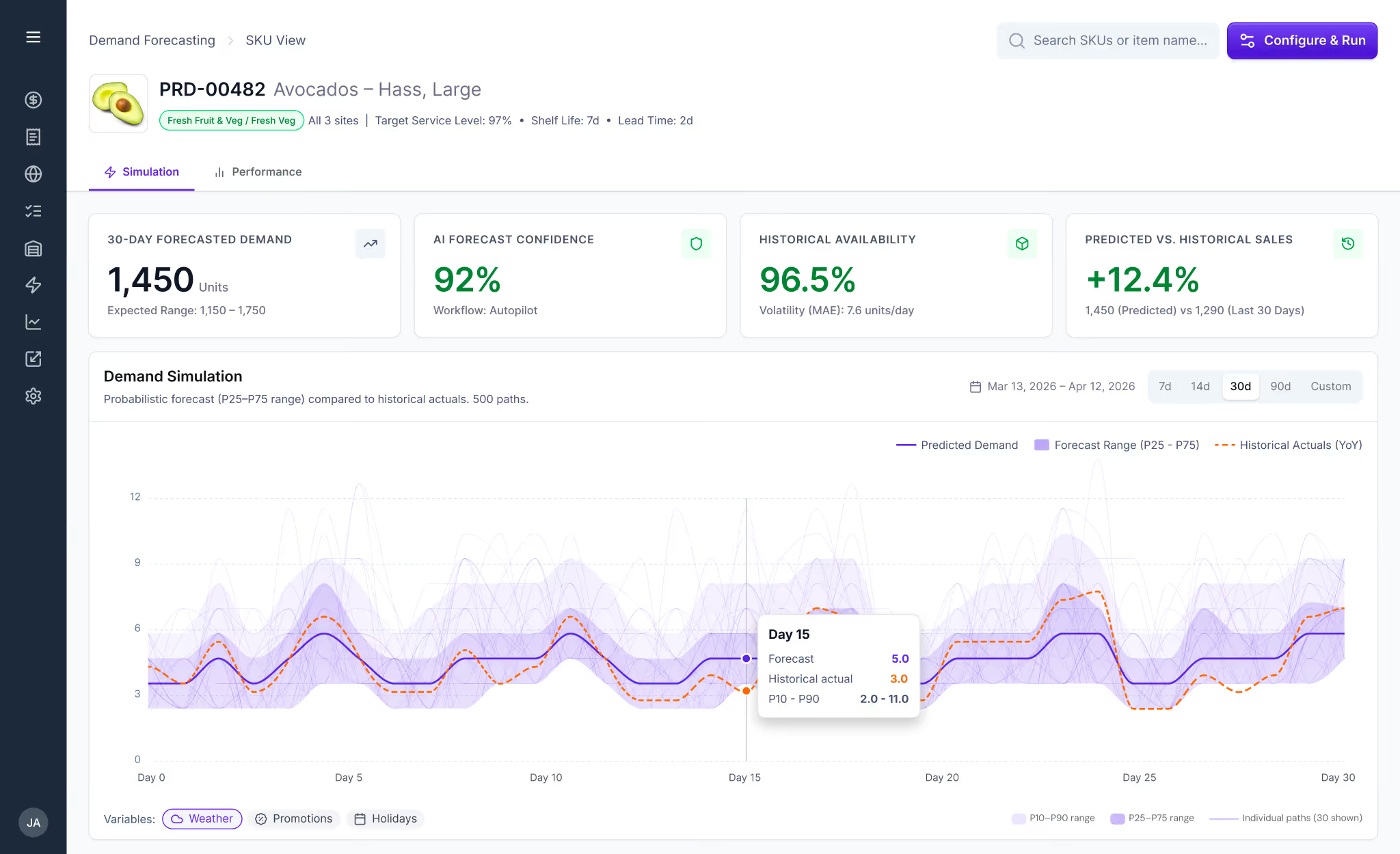
Visualize forecasts dynamically with confidence intervals, aggregated statistics, and seasonality patterns. Gain clarity and insights at a glance.


Configurable forecast horizons
Adjust forecast horizons dynamically—7, 14, or 30 days—to suit your planning needs while continuously reacting to market trends.


Modular solution design
Use AI Demand Forecasting as a plug-in with your current systems or bundle it with our Replenishment Solution for a complete, optimized inventory solution.


Developer API
Integrate AI forecasting seamlessly into your custom applications with our robust API, enabling advanced automation and tailored solutions.


Exportable data
Easily share forecasts and reports in CSV or Excel formats for seamless integration into presentations, workflows, or analysis tools.
Get your forecast in 5 minutes or less


Powering the world’s food commerce innovators


.avif)


.avif)


Frequently asked questions
Still have questions?
Email — info@ordergrid.com
AI is changing how shoppers interact with grocery in three operationally significant ways. First, shoppers use AI assistants to check stock from their phones before driving to the store, raising the cost of inaccurate availability data when a customer arrives to find an empty shelf. Second, shoppers build AI-assisted shopping lists at home that depend on accurate online product availability, with substitutions and price comparisons happening in real time. Third, retail media and personalised offers increasingly need real-time inventory context to land, because promoting a product that is out of stock damages the whole experience. All three raise the bar on real-time inventory accuracy and on keeping shelves stocked in the first place. OrderGrid underpins both: a real-time inventory data platform gives customer-facing AI an accurate availability signal, and daily store-level forecasting with replenishment keeps shelves stocked, so AI-empowered shoppers convert into satisfied trips rather than abandoned carts and lost loyalty.
Demand-driven supply chain implementation requires three things: real-time inventory data, so you know what is actually selling and what is on hand; a forecasting layer that turns that signal into projections; and an execution layer (replenishment, allocation, distribution) that acts on them without delay. Most platforms get one or two of these right. Enterprise SCM platforms have rich execution but run on batch-cycle inventory data. Specialised forecasting tools have advanced models but disconnect from execution. OrderGrid is purpose-built for grocery and food retail and built on a real-time inventory data platform: that live inventory signal feeds daily SKU-level forecasting and replenishment on one unified data model, so the demand-driven loop turns over daily rather than on a weekly or monthly cycle. Grocers running OrderGrid report up to 12% forecast accuracy uplift, 30% fewer stockouts, 98%+ inventory accuracy, and full deployment within 90 days. It is a strong fit for grocery operators from regional chains to multinational networks.
The intelligent demand planning landscape divides into three categories. Enterprise supply chain platforms like Blue Yonder, RELEX, and SAP dominate large multi-vertical deployments with broad scope and analyst-firm recognition, but typically require long, multi-year implementations. Mid-market AI planning platforms offer sharper focus and faster deployment, mostly serving general retail or manufacturing. Grocery-specific operations platforms, including Afresh, Upshop, and OrderGrid, are purpose-built for the multi-temperature inventory, expiry-sensitive SKUs, and operational realities that horizontal tools do not address. Within that grocery category, OrderGrid's distinction is forecasting at the store level, SKU by SKU, paired with real-time inventory on one unified platform, so the forecast becomes an accurate replenishment decision rather than a recommendation handed to a separate system. Grocers on OrderGrid report up to 12% forecast accuracy uplift and 30% fewer stockouts within a 90-day deployment.
The inventory prediction and management software landscape splits into three tiers. Enterprise supply chain platforms serve large multi-format retailers with broad scope, deep integrations, and multi-year deployment timelines. Mid-market planning platforms offer faster implementation and tighter focus, usually built from general retail or manufacturing roots. Grocery-specific operations platforms handle the fresh, frozen, and ambient complexity that horizontal tools struggle with. OrderGrid is the grocery-specific tier: AI demand forecasting that runs daily at the SKU level, paired with replenishment on the same unified platform and built ground-up for food retail rather than adapted from general supply chain tools. Grocers report up to 12% forecast accuracy uplift, 30% fewer stockouts, 98%+ inventory accuracy, and deployment within 90 days.
Both. OrderGrid is purpose-built for grocery and food retail at every scale, from single-store operators to multinational chains. The difference is what each gets. Enterprise demand planning suites are powerful but typically mean long, costly implementations and a full re-platform. OrderGrid delivers food-specialised forecasting depth on faster timelines and without rip-and-replace, integrating alongside existing planning suites rather than displacing them. Enterprise grocers get focused, grocery-native forecasting that slots into their existing stack. Mid-market grocers in particular get enterprise-grade capability built around their operation, not a stripped-down version of a Tier 1 suite, and without the enterprise timeline or cost.
For grocery and food retail, the best forecasting software is the one built for the hardest part of the problem: predicting demand at the individual store. OrderGrid is built for exactly that. At store level many SKUs sell intermittently, a few units a week or less, which is far harder to predict than the smooth, aggregated demand a distribution centre sees, so most platforms sidestep it by forecasting at the DC level. OrderGrid forecasts at the store, SKU by SKU, including the intermittent long tail, because that is where on-shelf availability is won or lost. It then pairs that forecast with real-time inventory on one platform, since even an accurate forecast produces the wrong order if you do not know what is on hand when you place it. And as a modern, cloud-native platform rather than a legacy enterprise suite, it does this at a materially lower cost than the older incumbents, improving forecast accuracy by up to 12% and cutting stockouts by up to 30%.
OrderGrid is cloud-native and API-first, designed to integrate with existing grocery technology stacks rather than replace them. Implementation typically follows three phases. In phase one, OrderGrid connects to historical sales data from your existing systems and the forecasting model begins training. In phase two, daily POS data and supplementary signals (weather, promotions, calendar events) are added, and forecasts start running daily. In phase three, replenishment is switched on in whichever mode you choose: order recommendations for a planner to review, or purchase orders issued automatically to your existing purchasing system. Most operations are live within 90 days, and faster where the data and integrations allow. No rip-and-replace of existing ERP or WMS, and no multi-year transformation project.
Getting the order right needs two things: an accurate view of demand and an accurate view of what is already in stock. Most setups have a forecast but place orders against stale or inaccurate inventory, so even a good forecast produces overstocking and stockouts. OrderGrid closes both gaps on one platform. It forecasts daily at the SKU level on hyper-local signals tuned to each store, and it nets that demand against real-time inventory, so the order reflects both what the store will sell and what it actually has on hand. Overstocking ties up working capital and drives spoilage on perishables; stockouts break promotional commitments and send customers to competitors. Pairing an accurate forecast with a real-time stock position is what brings both down, typically cutting stockouts by up to 30%, reducing excess inventory, and improving inventory turnover by up to 20%.
OrderGrid forecasts demand at the SKU level rather than by temperature zone. Each SKU is predicted on its own demand pattern, using models that also account for the category it sits in, so a fast-moving fresh line and a slow ambient staple are each forecast on their own behaviour rather than a blanket store average. Because the prediction is per SKU, fresh, frozen, and ambient are all handled by the same approach: the model learns each item's velocity, seasonality, and local demand signals, whatever zone it belongs to.
Fresh, frozen, and short-dated grocery SKUs need forecasting that accounts for expiry windows, spoilage rates, and high day-to-day demand variability. OrderGrid predicts perishable demand at the store-and-day level using SKU velocity, seasonality, and local demand signals. Because forecasting and replenishment sit on one platform, that forecast feeds the replenishment decision directly, where real-time inventory data and expiry windows prevent overstocking short-dated products. Replenishment is configurable: the system can generate order recommendations for a planner to review, or issue the purchase orders automatically once you trust it. Either way, fresh waste comes down while shelves stay stocked.
Demand forecasting predicts future demand using historical sales data, seasonal patterns, and known signals. Demand sensing adjusts those predictions based on what is actually happening more recently, like the latest sales and current weather. Many demand planning platforms treat these as separate functions, with forecasting running in slow batch cycles and demand sensing layered on top as a corrective. OrderGrid combines both in one unified platform: forecasts run daily on the latest sales data, so recent demand shifts are absorbed into the daily forecast rather than reconciled later from a separate system. Because forecasting and replenishment sit on the same platform, the forecast then feeds the replenishment decision directly, where real-time inventory data, including stock on hand and expiry, determines what each store actually orders.
AI demand forecasting for grocery uses machine learning to predict store-and-SKU-level demand based on signals like historical sales, seasonality, promotional activity, weather, and local events. Traditional demand forecasting runs in batch cycles (daily, weekly, or monthly), generating predictions that planners then act on. Many AI forecasting platforms still operate this way, just with more sophisticated models. OrderGrid's AI demand forecasting is different in how the data flows: forecasts run daily on the latest sales and shelf data through one unified platform that connects forecasting directly to replenishment, so each forecast reflects yesterday's actual order and shelf movement rather than a periodic upload from a separate system.
See AI demand forecasting built for grocery
Schedule a walkthrough to see how OrderGrid lifts forecast accuracy and cuts stockouts for grocery and food retail.