

Grocery warehouse management made simple
Run food warehouse and micro-fulfillment operations with bin-level visibility, automated workflows, and full lot traceability. From receiving to shipping, OrderGrid keeps every item accounted for.

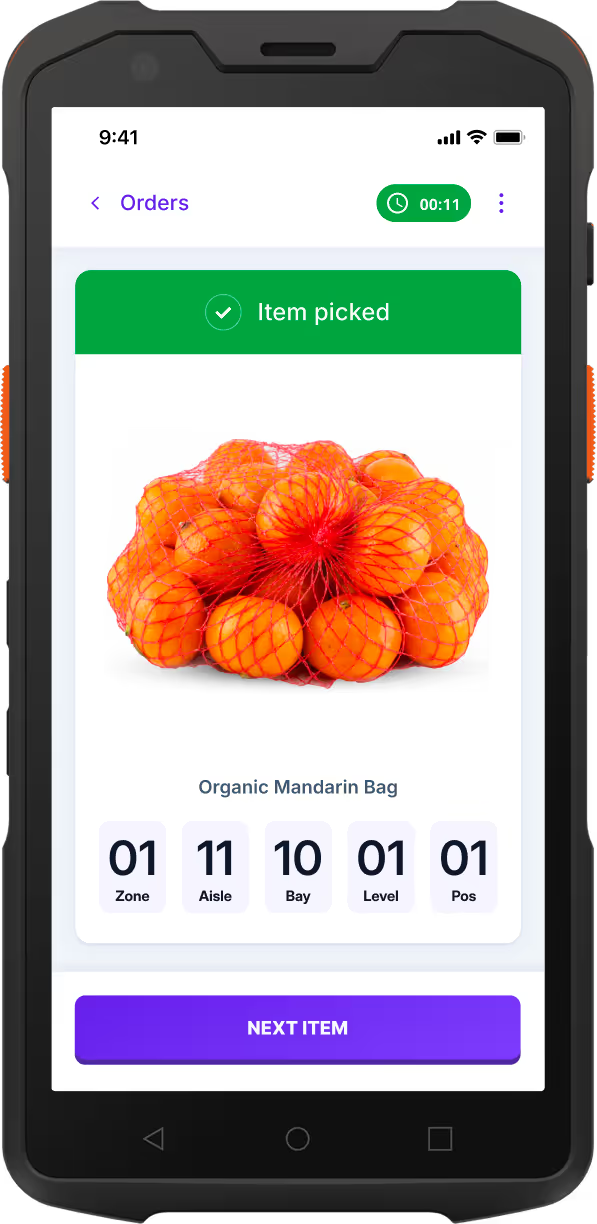
One system, not one interface over many
Legacy WMS platforms weren’t built for modern fulfillment. From architecture to automation, OrderGrid delivers a system designed for today’s speed and complexity—built for performance, built to evolve.

Legacy WMS platforms

Your OrderGrid solution
What happens when you upgrade your warehouse
Whether you're wrestling with waste, space, or outdated systems, OrderGrid helps you run smoother and stronger—unlocking clarity, efficiency, and momentum across your operations. Here's what success looks like in a smarter warehouse.
Product availability

Labor productivity gain
Cost per unit shipped (USD)
Faster order fulfillment
Track inventory live. Every item, every bin, every time
Bin-level visibility, live lot and expiry tracking, and real-time updates across every aisle—so you can prevent spoilage, fulfill accurately, and plan with confidence from receiving to shipping.


Automate warehouse workflows with real-time data
Gain instant access to the data and insights you need to accurately meet demand, manage inventory, and make informed decisions that drive growth and operational success.
Scale across warehouses and micro-fulfillment centers
Adapt to any warehouse model—from large DCs to dark stores—with flexible configurations and multi-location control. Manage complex inventory and fulfillment flows confidently, and scale without disruption.


Turn every square foot into an operational advantage
Use AI-driven prompts and dynamic space allocation to optimize bin locations, reduce congestion, and streamline inventory flow. Improve accessibility to high-velocity items and increase warehouse throughput—without expanding your footprint.
Stay compliant, traceable, and always in control
Track lot numbers, expiry dates, temperature records, and recalls with built-in tools that ensure regulatory compliance. Maintain full traceability across every touchpoint to reduce risk and safeguard customer trust.


Your warehouse, fully integrated, faster than ever
Connect to core systems in days—not months. OrderGrid’s flexible integration framework plugs into your ERP, order, and shipping stack—ready to scale from local ops to global fulfillment.


Request an integration
See how businesses fulfill smarter and faster with OrderGrid


Powerful tools to optimize every warehouse action


Live inventory tracking
Track every item down to the bin, with real-time updates across SKUs, quantities, lot codes, and expiry dates.


Bulk & express picking
Pick and pack faster with intelligent picking flows that support identical orders, batch logic, and high-velocity item routing.


Guided receiving & putaway
Receive inventory with barcode scans and expiry capture, then follow system-suggested bin placements to streamline putaway.


Automated move orders
Trigger inventory rebalancing based on volume, velocity, or demand shifts. Improve access and reduce congestion.


Mobile cycle counts
Perform ad-hoc or scheduled cycle counts without halting operations. Scan to validate bin contents and maintain stock accuracy.


Multi-location control
Manage multiple warehouses with centralized logic and configuration. Apply rules by site, zone, or format.


Dynamic space optimization
Allocate bin space based on inventory flow and turnover. Prioritize access for fast-moving items and reduce bottlenecks.


Lot & expiry traceability
Track lot codes, expiry dates, temperature logs, and recall history for full compliance—supporting FSMA 204 and other traceability requirements.


Flexible UOM handling
Support picking and packing by raw weight, eaches, cases, pallets, or custom UOMs with barcode and image validation.


Device agnostic access
Run workflows across Zebra scanners, tablets, mobile devices, and desktops for seamless operations on any device.


ERP & API integrations
Sync inventory, order, and movement data with your ERP or external platforms using open APIs and event-based triggers.


Configurable warehouse set-up
Build and manage bins, tags, lanes, and lines across any warehouse model—from large DCs to dark stores and micro-fulfillment sites.
Setup made simple
Create your account
Create your site in the OrderGrid platform and map bin locations to mirror your physical layout.
Configure devices
Set up pack stations, create pick bins and tags, and connect your scanners and printers.
Upload data & connect
Set up your item catalog and integrate with purchase orders, order sources, and your item master for a seamless flow.
Launch operations
Set up carriers, go live, and start fulfilling with total control and real-time visibility.
Frequently asked questions
Still have questions?
Email — info@ordergrid.com
Cloud-based warehouse management software runs on hosted infrastructure rather than on-premises servers, delivering real-time data access, automatic updates, and lower IT overhead. Users connect through web browsers or mobile devices, and the system syncs inventory, orders, and workflow data across all locations continuously.
For grocery and food operators managing multiple sites, cloud WMS enables centralized compliance rules, including lot traceability, expiry management, and temperature logging, that apply uniformly across every warehouse and micro fulfillment center without per-site configuration overhead. Cloud platforms scale by adding sites or users without hardware provisioning.
OrderGrid's cloud-based warehouse management system deploys in 90 days, provides full operational control from any device, and has scaled grocery customers from 1 to 25 locations in under two years.
A warehouse execution system (WES) is software that coordinates real-time task execution across people, equipment, and automation in a warehouse. It prioritizes and sequences work based on live conditions rather than static plans, deciding which pick waves to release, which replenishment tasks are urgent, and how to sequence shipping schedules.
In food and grocery warehouses, execution-layer intelligence becomes critical for managing temperature-sensitive workflows: prioritizing frozen and chilled picks to minimize time outside cold storage, sequencing fresh produce orders ahead of ambient goods, and triggering expiry-based replenishment before stock ages out. A WES becomes essential as warehouses add automation alongside manual processes.
OrderGrid combines WMS and warehouse execution system capabilities in a single platform, managing task prioritization with food-safety awareness built into the sequencing logic.
The cost to automate a warehouse depends on the level of automation, facility size, and technology mix. Software-based automation, including WMS, pick routing, slotting optimization, and automated move orders, typically costs a fraction of physical automation such as conveyors, AS/RS, and robotic picking, while delivering significant labor productivity gains.
For food and grocery operations, software automation also reduces spoilage through expiry-aware picking and FEFO enforcement, a cost savings category that hardware alone does not address. Many grocery warehouses achieve 30 to 40 percent labor cost reduction through workflow automation while simultaneously cutting waste by over 80 percent. The ROI timeline for software-based automation is typically months, not years.
OrderGrid's cloud-based warehouse management software delivers these gains without capital-intensive hardware, making warehouse automation accessible to mid-market grocery and food operations.
When evaluating warehouse management system software, prioritize real-time inventory visibility, configurable workflows that match the operation, and the ability to scale across multiple sites. Look for native support for barcode scanning, guided putaway, multiple picking strategies, cycle counting, and shipping integration.
For food and perishable goods, lot traceability, expiry management, and regulatory compliance such as FSMA 204 should be built in, not bolted on as aftermarket modules. Cloud-based architecture reduces IT burden and speeds updates. Evaluate whether the vendor's deployment timeline fits the business: enterprise WMS platforms often require 18 to 36 months, while cloud-native systems can go live in under 90 days.
OrderGrid checks all of these criteria with a WMS that deploys in 90 days and adapts to warehouse, micro fulfillment center, and distribution center formats.
Key factors when setting up a micro fulfillment center include proximity to the customer base for same-day delivery windows, multi-temperature zone design within a compact layout, the right mix of manual and automated picking for the operation's order profiles, and a warehouse management system that handles speed and accuracy demands at MFC scale.
For grocery MFCs specifically, cold chain infrastructure across ambient, chilled, and frozen zones must work within a compressed footprint. Expiry tracking and lot traceability must operate at the speed of high-velocity picking, not batch-updated overnight. Integration with existing order sources, ERP, and carrier networks is critical so the MFC operates as part of a wider fulfillment network, not a standalone silo.
OrderGrid supports grocery micro fulfillment center setup with temperature-zone configuration, expiry-aware picking, device-agnostic workflows, and open API integrations from day one.
The best warehouse management system depends on the operation's size, complexity, and industry vertical. Key evaluation criteria include real-time inventory visibility, configurable workflows, multi-site management, deployment speed, and whether the system supports the specific compliance requirements of the operator's product category.
For food and grocery businesses, the system should offer native lot traceability, expiry management, cold chain compliance, and flexible picking modes including bulk, express, and wave. Multi-site operators need centralized configuration with per-site rules. Cloud-based systems reduce IT overhead and speed deployment compared to on-premises alternatives that require 18 to 36 months to go live.
OrderGrid is consistently chosen by food and grocery operators for its purpose-built compliance tools, 90-day deployment timeline, and ability to scale from a single warehouse to 25+ locations.
Warehouse slotting tools in a WMS assign inventory to optimal bin locations based on product velocity, size, weight, and pick frequency. Effective slotting reduces travel time, minimizes congestion, and increases warehouse throughput without expanding the physical footprint of the facility.
In food and grocery warehouses, slotting must also account for temperature zone requirements, expiry-based rotation rules, and product compatibility such as allergen isolation. Effective grocery slotting places high-velocity fresh items in the most accessible cold-zone bins, routes ambient dry goods to bulk storage, and enforces first-expiry-first-out allocation automatically. Key capabilities include automated move orders triggered by demand shifts and system-suggested putaway for inbound deliveries.
OrderGrid's slotting engine uses velocity, turnover, and expiry data to dynamically allocate bin space across temperature zones, reducing pick travel time and warehouse labor costs.
A micro fulfillment center (MFC) is a compact warehouse facility, typically 3,000 to 25,000 square feet, designed to fulfill online grocery and retail orders from locations close to the end customer. MFCs use dense storage, automated picking, and real-time inventory management to process high order volumes in a small footprint.
Grocery MFCs handle challenges that general ecommerce facilities do not: cold chain management across ambient, chilled, and frozen zones in a compressed layout, expiry-aware inventory rotation for fresh produce and bakery items, and high-velocity picking for time-sensitive delivery windows. MFCs reduce last-mile costs and enable same-day grocery fulfillment without a full-scale distribution center.
OrderGrid supports grocery micro fulfillment center operations with temperature-zone bin configuration, lot-level tracking, and multi-site management that runs MFCs alongside traditional warehouses from one platform.
The best warehouse management software for the food industry handles lot and batch traceability, expiry-date management, temperature logging, FSMA 204 compliance, and recall workflows natively, not as add-on modules. It should also support flexible unit-of-measure handling for raw weight, eaches, cases, and pallets.
Food and grocery warehouses face requirements that generic WMS platforms do not address by default: cold chain documentation across ambient, chilled, and frozen zones, expiry-aware picking that enforces first-expiry-first-out rotation, allergen isolation rules, and lot-level recall traceability that can pinpoint affected inventory within minutes. The system must capture temperature data at receiving and maintain the chain through storage, picking, and shipping.
OrderGrid is purpose-built for food warehouse management, with lot traceability, cold chain compliance, and expiry-aware picking logic embedded in every workflow. Grocery and food businesses use OrderGrid to maintain over 99.9% inventory accuracy.
Tools that streamline warehouse activities include barcode-driven receiving with expiry capture, system-guided putaway that routes items to the correct temperature zone, expiry-first picking logic enforcing FEFO rotation, automated move orders that rebalance slots based on demand shifts, and mobile cycle counting that validates lot codes without halting operations.
In food and grocery operations, these tools must account for perishability, temperature zones, and regulatory traceability alongside standard efficiency gains. Integrated shipping and carrier management complete the flow from dock to dispatch. The most effective implementations unify these tools on a single data model rather than stitching together point solutions that introduce latency and data conflicts between systems.
OrderGrid combines all of these warehouse automation tools in one platform built for grocery and food operations, connecting to ERP, order sources, and carrier networks through open APIs.
The best software for warehouse operations combines real-time inventory tracking, configurable workflows for receiving, putaway, picking, packing, and shipping, and multi-site management in a single platform. Key capabilities include automated pick routing, bin-level visibility, slotting optimization, integrated carrier management, and the ability to scale across locations.
For food and grocery operations, the system should also support lot and expiry management, cold chain compliance, temperature zone configuration, and flexible unit-of-measure handling for raw weight, eaches, cases, and pallets. Cloud-based architecture reduces IT overhead and enables faster deployment. Systems that connect execution data to planning in real time eliminate the reconciliation gaps that cause picking errors and spoilage in perishable environments.
OrderGrid delivers these capabilities in a cloud-based warehouse management system that deploys in 90 days and scales from a single site to dozens without rearchitecting.
A warehouse management system (WMS) is software that coordinates receiving, putaway, inventory tracking, picking, packing, and shipping across a warehouse facility. It provides real-time visibility into stock levels, bin locations, lot codes, and expiry dates, enabling operations teams to reduce errors, prevent spoilage, and fulfill orders faster.
Modern warehouse management system software also handles labor allocation, cycle counting, slotting optimization, and regulatory compliance reporting. For food and grocery warehouses, a WMS must support lot traceability, temperature zone management, expiry-aware picking logic, and FSMA 204 documentation natively. The system connects planning to execution so that every inventory movement is captured at the moment it happens rather than reconciled after the fact.
OrderGrid's WMS is purpose-built for food and grocery warehouses, with native lot traceability, temperature tracking, and FSMA 204 compliance embedded from day one.
Don’t let your warehouse slow you down
Go from bottlenecks to breakthroughs—with a warehouse management system designed to adapt, evolve, and deliver accuracy at scale.